|
"Hi, Ethan. Just wanted to remind you this guitar is incredible, gets better every day it seems and just discovering the ease and clarity of play even @ 19th fret!"
In a recent online forum discussion among luthiers about the differences between guitarras flamencas blancas, guitarras flamencas negras, and classical guitars, I posted the following:
To me, a blanca (cypress back and sides), a negra, and a classical guitar are generally distinct. The soundboards of traditional flamenco guitars, as opposed to classical guitars, are either thinner, or braced more lightly--or both--which gives the sound of flamenco guitars more of a rough, raw, raspy character. Often the backs and sides of flamenco guitars are also thinner, though not in the case of mine. I use spruce almost exclusively for soundboards. Although I am afraid that talking about sound quality may be like dancing about architecture, I think a proper flamenca blanca has low sustain and what used to be called a "tinny" tone--less full and round, more fundamental, I suppose, and somewhat rough around the edges. The sound of an Indian rosewood negra is close to that of a blanca, but with more depth. I find that other rosewoods, such as Bolivian (Santos) or Brazilian, give a mellower, more refined sound, as does hard maple. Classical guitars have more sustain and projection--more like a piano, perhaps. My classical guitars sound totally different from my flamenco guitars. And I keep the same body depth and plantilla for all my guitars. Currently the differences between my classicals and flamencos are the soundboard bracing--including the biggest brace, the bridge (and thus neck angle); the scale lengths (650 mm for classicals and 656 for flamencos, generally); and that I use a mahogany heel block for classicals, which I find adds sustain to an otherwise cedro neck. 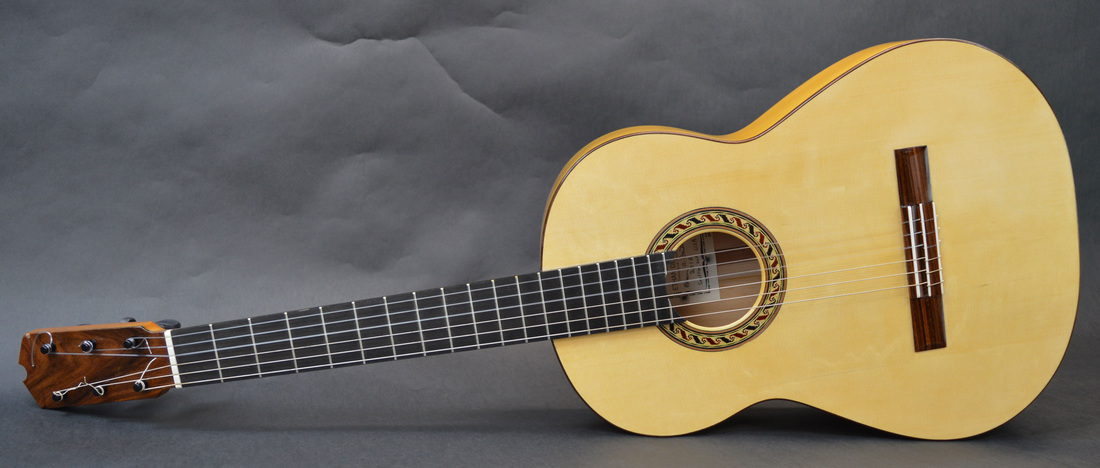
I came up with the name "Basic Model" while trying to avoid using the word "Segunda" ("Second" in Spanish), which is abbreviated by the numeral "2" followed by a superscript "a," sometimes referred to by English speakers as "2A." Many artisans sell their work that is not up to their usual standards as "seconds" and I didn't want to give the impression that there is anything inferior about this model in terms of sound quality or playability. There isn't. In terms of function these guitars are just as good as any of my others. I wanted to have something to offer at a lower price and realized that I could do this by eliminating some of the more subtle decorative elements. So these guitars don't have purfling lines beside the bindings on the sides or on the soundboard and they don't have mother of pearl inlay on the ends of the Pegheds tuners. Moreover, I may use rosettes which I made and then decided were not perfect enough for my more expensive ("Standard") model. Since my signature rosette design, the woven design of natural wood colors, is particularly difficult to make, I was thinking to exclude it from the Basic Model. So if you ask me to make you a Basic Model guitar with my signature rosette design, I am apt to quote you a slightly higher price than for simply a Basic Model. Thank you for understanding.
Dear Readers,
When using the contact form to contact me, please be sure that the email address you give will accept emails from senders not already on your list. I received an inquiry from Tim (Timothy) Allred a few days ago. I have not been able to get an email through to him because his mail system rejects mail from unfamiliar senders. And he didn't give a phone number on the contact form. Tim asked about the difference between my Basic Model Blanca and my Standard Model Blanca. Here is the message I wanted to send to him in an email: Hi, Tim. Thanks for writing. The differences are essentially in the decoration: The basic model does not have purfling, the thin decorative lines next to the edge binding, which I use on the sides and soundboard on the standard model. Also the rosette in the basic model may be one that I felt was not executed as well as it should be for the standard model, or it may simply not be my signature “basket-weave" rosette. And there is no pearl or abalone inlay on the ends of the pegs (Pegheds, mechanical pegs). To make it even more complicated to explain, I am using Port Orford cedar for the back and sides of the basic model and Mediterranean cypress of the standard model—although I have in the past used POC for some of the best standard models that I have produced (including the one I play every day). The POC backs of the basic model are composed of four pieces, instead of the usual two, although you wouldn’t know it if I didn’t tell you. I happen to have a big stash of this wood which I re-sawed from large planks, and in order for it to be “quarter sawn” I had to re-saw it so that the maximum width is 4”. There is no difference in sound or playability. I look forward to being your luthier. Sincerely, Ethan |
AuthorEthan Deutsch, Luthier Archives
July 2026
|
 RSS Feed